


Spaces to listen
Rooms built for sound, and why we need them
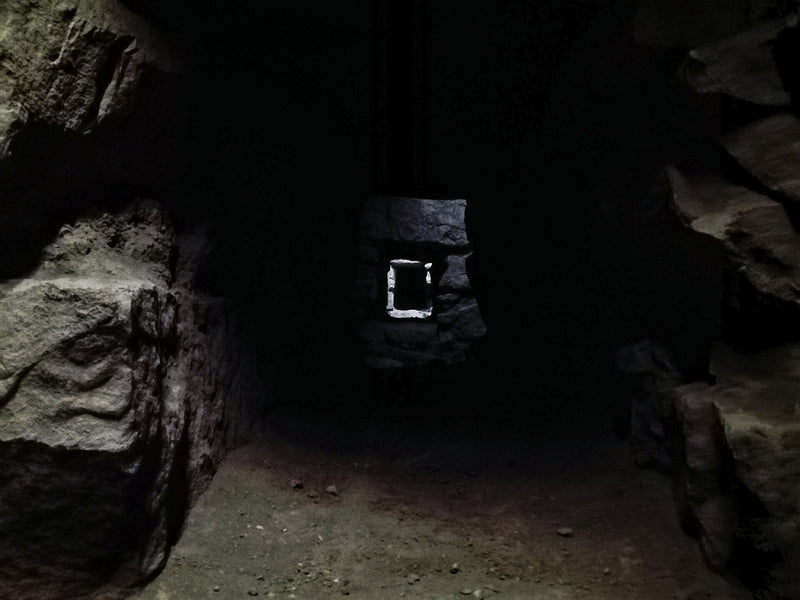
Blown like a trumpet, a Strombus conch shell or pututu holds a single note, close to the pitch of a speaking voice and thick with overtones, creating a drone-like sound that would sit in any modern-day ambient set. Chavín de Huántar, more than 3,000 metres up, is a UNESCO World Heritage site in Peru. In 2001, 20 ancient decorated conch shell trumpets were found at Chavín, in its dark underground maze of corridors, small rooms and alcoves.
Archaeoacoustic researcher Miriam Kolar measured how the ducts connecting the corridors boosted the voice-like drone, making it up to four times as loud. One duct ran from the mouth of a hidden figure towards the plaza, so the sound could have seemed to come from a source nobody could see. Annie Goh writes “this had a disorienting effect, as the perceived direction of sound was constantly shifting in space.”
There is evidence the rituals also involved psychoactive plants alongside sound, to alter the senses. Here is a space that seems built to act on whoever entered it.
Underground again in 1988, Pauline Oliveros climbed down into a cistern in Washington State with Stuart Dempster and Panaiotis, making the recording that became Deep Listening. The vast concrete space had a 45-second reverberation time. Their session produced 4-tracks: "Lear", "Suiren", "Ione", "Nike", released on CD and cassette. This was a space no one built for music, yet it shaped everything played in it.
As Oliveros wrote in Quantum Listening: “Each composer represented in Deep Listening has a very individual style of composition. As we improvise together, and listen intensely to one another, our styles encounter in the moment to make collective music.”
So how much of listening is in the room, the acoustics, the space - and how much is what we bring into it?
In Bodies of Sound, Camae Ayewa of Black Quantum Futurism says on the act of listening: “I don't assume that I’m listening… I have to go through this practice of putting something on and really getting in the space of listening… It's the idea of slowing down.”
Fast forward to a basement in Shoreditch in 2000. Plastic People, the legendary club driven by Ade Fakile’s obsession with sound, was where clubbers came purposefully, to listen collectively. The club's pitch-black interior meant clubgoers could listen to the newest electronic sounds through a Funktion-One sound system, with the focus on how the sound made you feel, rather than on the DJ. At Chavín de Huántar, hiding the source of sound served authority; at Plastic People it kept the music at the centre.
Sean McAuliffe and Ade Fakile at Plastic People. Photo: Mr Beatnik
And what about smaller spaces to listen? Over the last decade there has been an eruption of listening bars taking their lead from Japan’s rich scene. Kissa in Japan originated back in the 1920s, as cafes where you could quietly listen to global jazz and classical records. Spiritland, London’s audiophile listening bar, is opening a new venue at the Barbican this October where an album is played in full at 5pm through a custom Living Voice system. The appetite for these spaces is clear.
From ancient temple rituals, to an underground cistern, to nightclubs and listening bars, we have long been curious about how different spaces affect how we take in sound. Rooms designed for listening encourage the kind of attentiveness Oliveros built her life’s work around. But like Ayewa says, getting there is a practice. For me, it’s increasingly difficult to tap into a version of deep listening until the space I’m in is conducive to it. In a world built for distraction, choosing a room made for listening is a quiet kind of resistance.
Further reading: Bodies of Sound (eds. Irene Revell and Sarah Shin, Silver Press, 2024) and Quantum Listening (Pauline Oliveros, Ignota). Both stocked at Slow Listen.